Chhattisgarh moves more paddy than almost any state in India. The technical profession that keeps that economy standing is also the least discussed career in the district.
IN BRIEF
Chhattisgarh targets 16 million tonnes of paddy procurement this season across 2,739 village centres, making it one of the two largest procurement economies in India.
India operates at roughly 47 percent farm mechanisation against 59.5 percent in China and 95 percent in the United States. That gap is not a statistic. It is a job description.
Measured harvest and post-harvest losses run from under 4 percent in cereals to over 15 percent in fruits, and the difference between the best and worst regions is largely equipment.
Agricultural engineering sits almost entirely in physical, site based, accountable work, which is the category automation reaches last.

Every November, something happens in Chhattisgarh that almost nobody outside the state pays attention to.
Across 2,739 village level centres, more than two million farmers begin selling paddy to the state at a minimum support price of ₹3,100 per quintal, the highest offered by any state in India. The target this season is 16 million tonnes. Payments run to tens of thousands of crores. By volume, this is one of the two largest agricultural procurement operations in the country.
It is also, quietly, one of the largest logistics, storage, drying, handling and quality control problems in the country. And it is run with a technical workforce that almost nobody is deliberately training.
This article makes the case that agricultural engineering is the most underpriced technical career available to a student in this state, and sets out the evidence for that claim.
01 Start with the scale, because most people underestimate it
The instinct outside Chhattisgarh is to think of the state as a steel economy with farming attached. The numbers do not support that framing.

The procurement operation, in the terms that actually describe its size. Sources: Government of Chhattisgarh cabinet decisions on paddy procurement, KMS 2025-26.
Consider what those four numbers imply operationally. Sixteen million tonnes of grain has to be received, weighed, tested for moisture, bagged, stacked, transported, stored through a monsoon, milled and dispatched. Twenty five lakh individual transactions have to be recorded, verified and paid within days. Two thousand seven hundred sites have to function simultaneously, in November, in rural districts, with no margin for a week of unseasonal rain. That is not agriculture. That is industrial operations, and it happens to involve grain.
02 The gap that defines the opportunity
India operates at roughly 47 percent farm mechanisation. NABARD attributes 40 to 45 percent of farm activity to powered machines. The comparison with agricultural economies of similar ambition is unflattering.
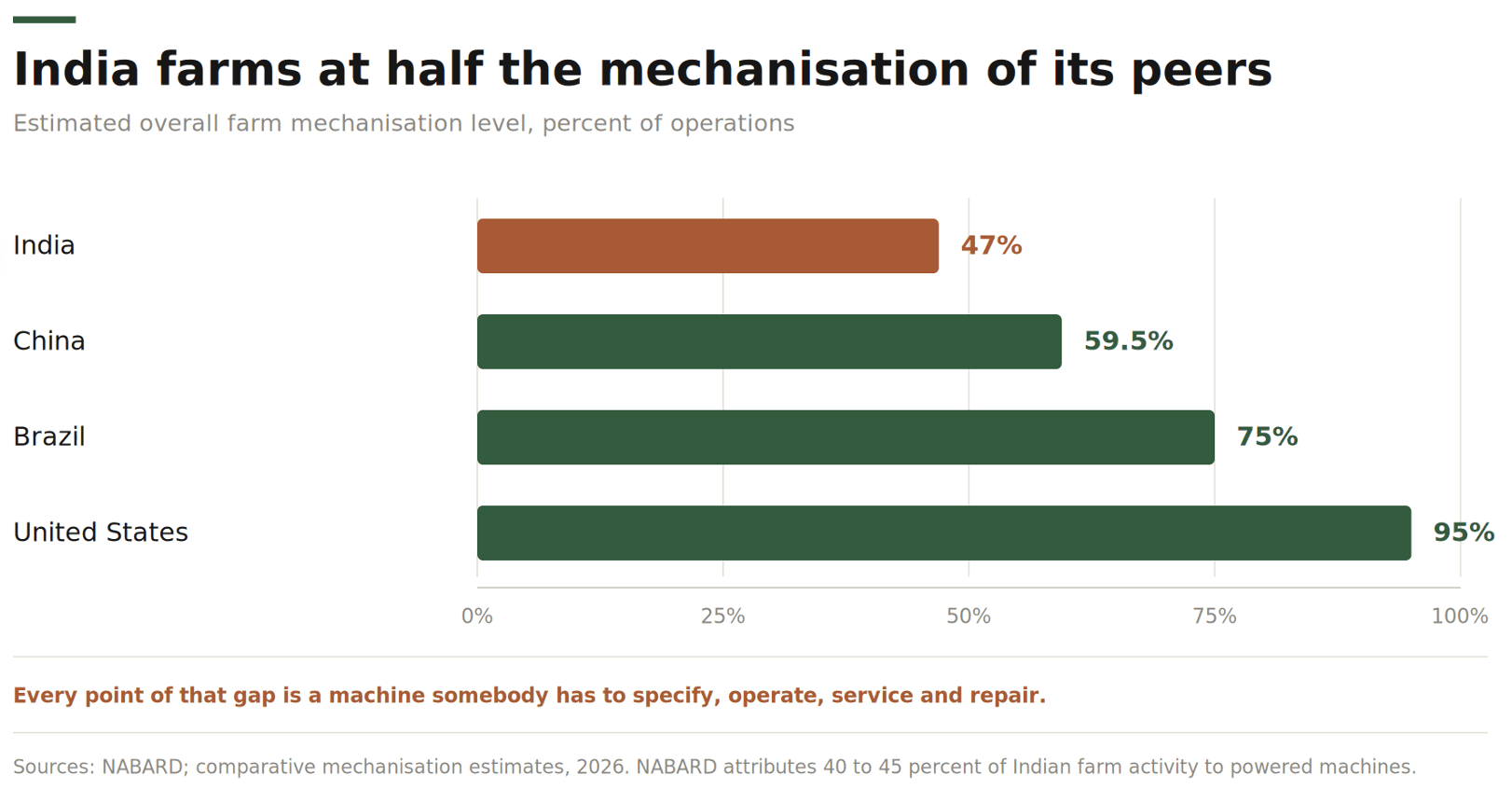
India is closer to the bottom of this group than the middle. Sources: NABARD and comparative mechanisation estimates, 2026.
It is tempting to read a chart like that as a national failure. Read it instead as an inventory of work that has not been done yet.
Closing even half the distance to China means a very large number of machines entering Indian fields over the next decade. Every one of those machines has to be specified for a particular soil and crop, financed, delivered, commissioned, operated by someone trained, maintained on a schedule, and repaired when it fails in the middle of a harvest window that does not wait.
None of that is done by an agronomist. All of it is done by an agricultural engineer, or by nobody, which is the current arrangement in much of the country.
03 What the country loses in the gap
The cost of under mechanisation is not theoretical. It has been measured.
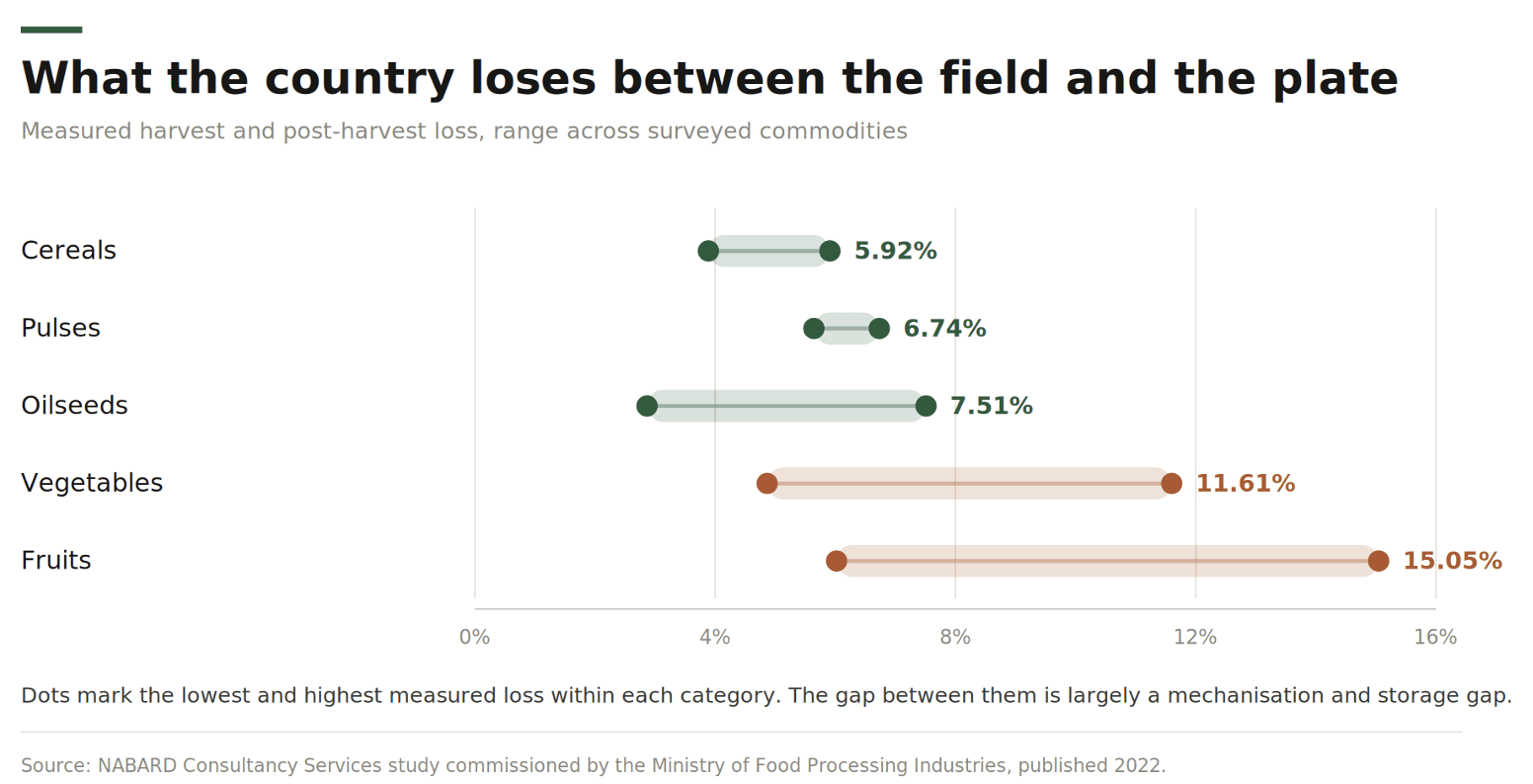
Measured harvest and post-harvest losses, range across surveyed commodities. Source: NABARD Consultancy Services study for the Ministry of Food Processing Industries, published 2022.
The same body of research puts India’s annual food loss from harvest and post-harvest causes at roughly 17.7 billion dollars. The losses concentrate in exactly the operations an engineer owns: harvesting method, threshing, drying, moisture control and storage.
04 Where an agricultural engineer actually works
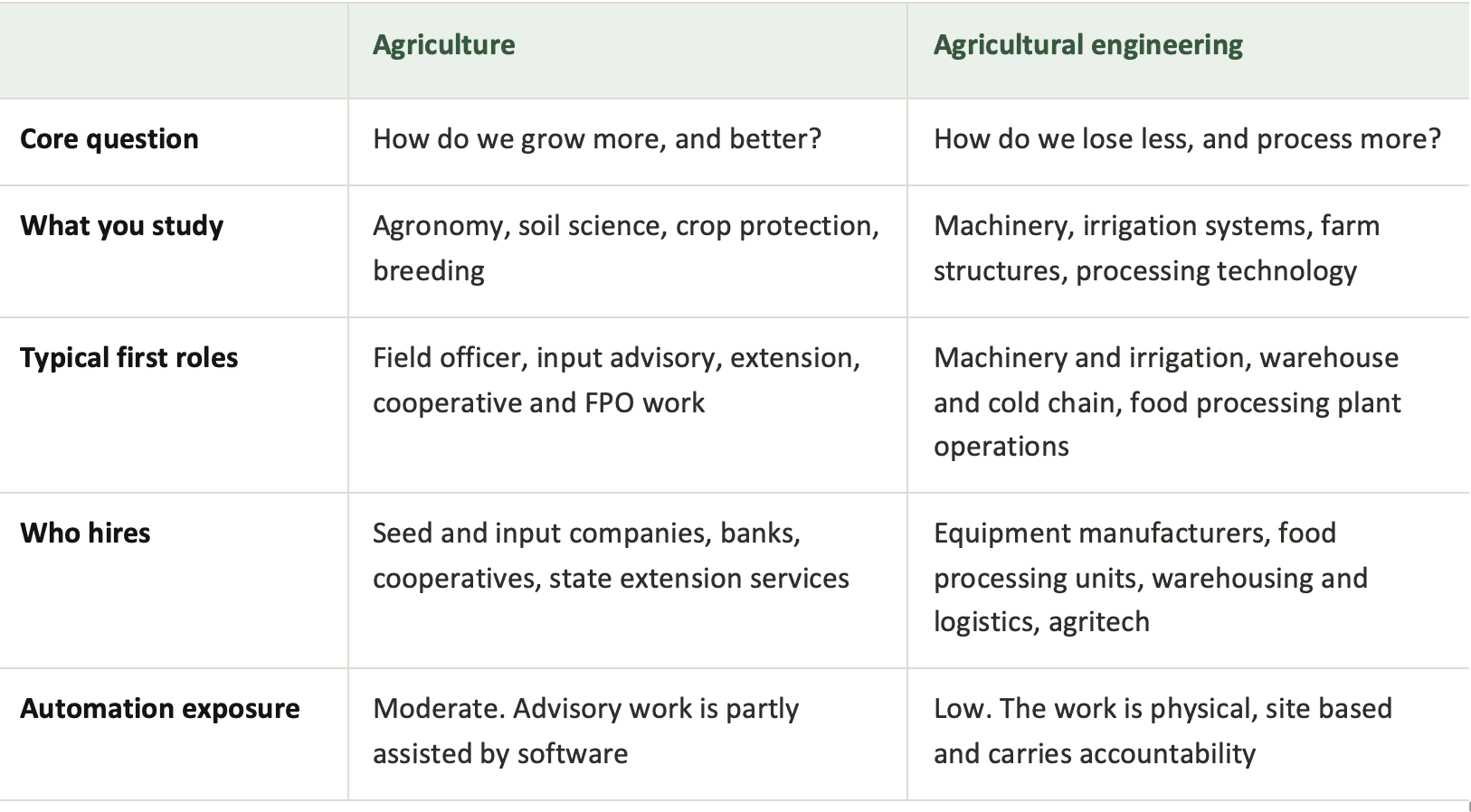
The most common confusion we encounter in the admissions office is between agriculture and agricultural engineering. They are not variations of the same degree. They answer different questions.
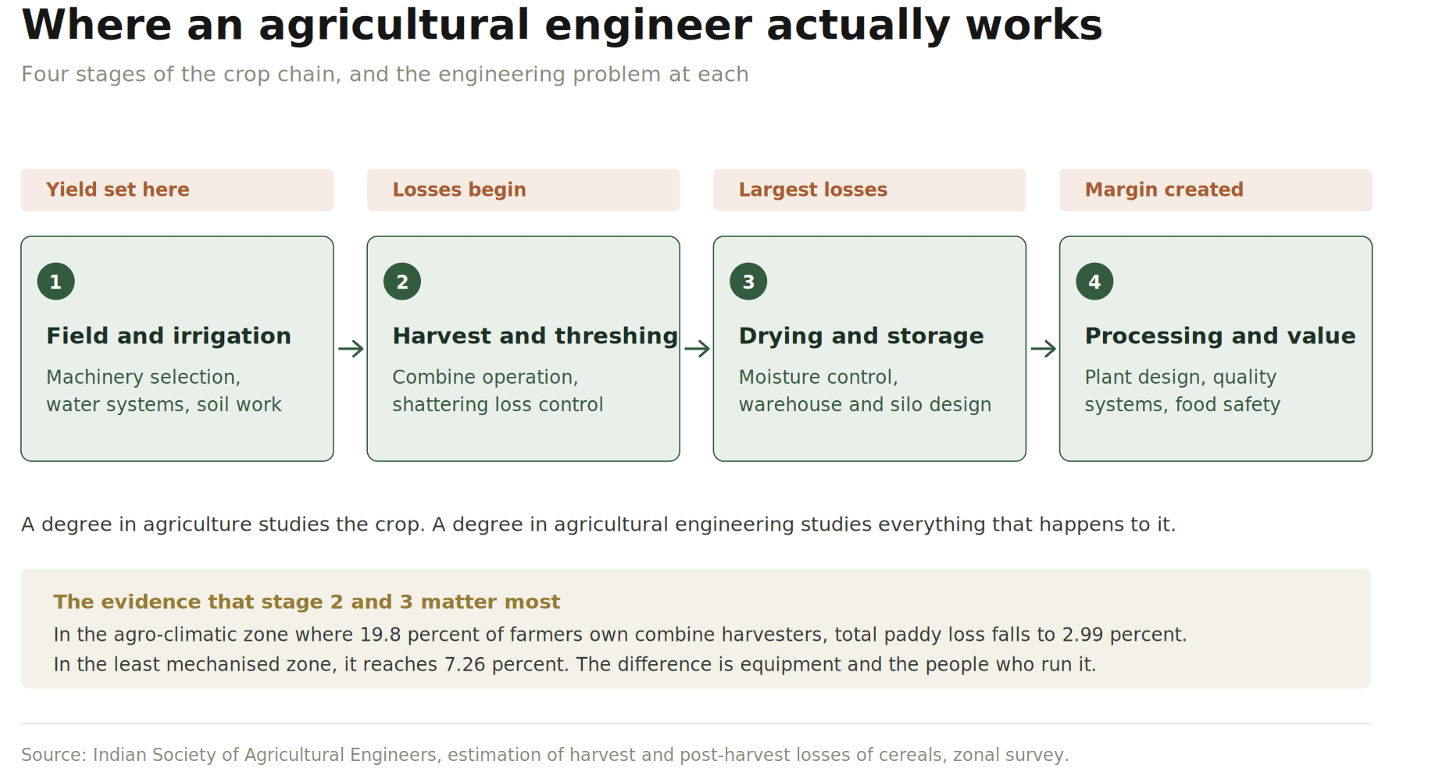
The crop chain, and the engineering problem at each stage. Source: Indian Society of Agricultural Engineers, zonal loss survey.
05 Five reasons this career is underpriced
Underpricing means the perceived value of something has drifted below its real value. Five specific things have caused that drift here.
1. It is invisible in the way careers get discussed. Students hear about engineering through software, and about agriculture through farming. The profession that sits between them has no cultural shorthand, so it never enters the conversation.
2. The word agriculture is doing the damage. Many families read it as a step backwards, associated with the life they worked to move a generation away from. The actual work is plant engineering, control systems and logistics.
3. Demand is dispersed rather than concentrated. There is no single large employer running a visible campus drive. Demand sits across equipment dealers, processors, cold chain operators, cooperatives and agritech firms, which makes it real but hard to see.
4. Policy support arrived faster than awareness. Chhattisgarh’s Industrial Development Policy 2024 to 2030 treats food processing as a thrust sector with substantial incentives. Capacity is being built ahead of the workforce that will staff it.
5. It is protected from the thing everyone is worried about. A model can optimise an irrigation schedule. It cannot install the pump, diagnose why the borewell is drawing air, or sign off that a cold store meets food safety standards.
06 Why we take this seriously
Durg Education and Charitable Society opened Chhattisgarh’s first private agriculture and agricultural engineering colleges in 2002. That was not a market driven decision at the time. Almost nobody was asking for those programmes.
Twenty four years later, the state runs one of India’s largest procurement operations, food processing sits in the industrial policy as a thrust sector, and the mechanisation gap is finally being treated as a national priority rather than a rural inconvenience.
We would rather be honest about what that means than claim foresight. We did not predict the market. We were early to a field that took two decades to be recognised, and the students who came through those programmes were early with us.
What we can say with confidence is that the conditions now favour them in a way they did not back in time.
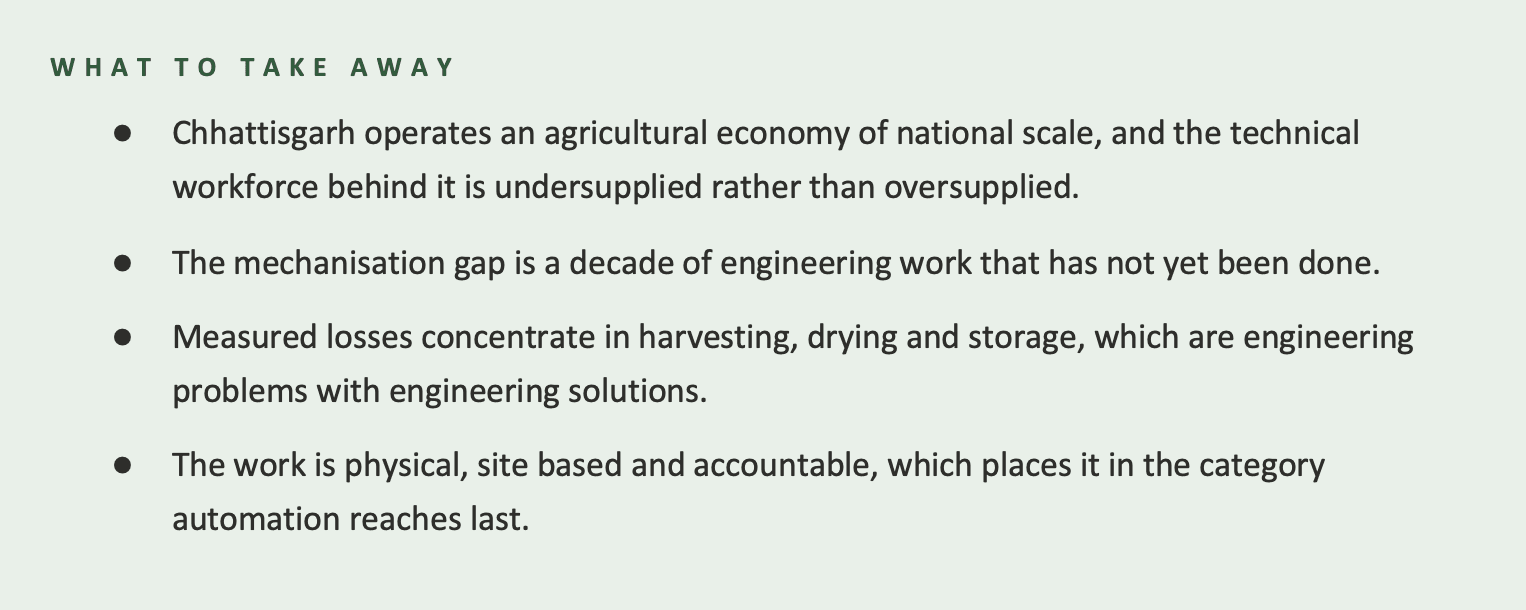
The rice leaves this state in enormous quantity every year. Whether it leaves efficiently, with the value added here rather than somewhere else, is an engineering question. It deserves engineers.